Whole Food vs. Synthetic Supplements for Your Doberman: Navigating Nutritional Choices
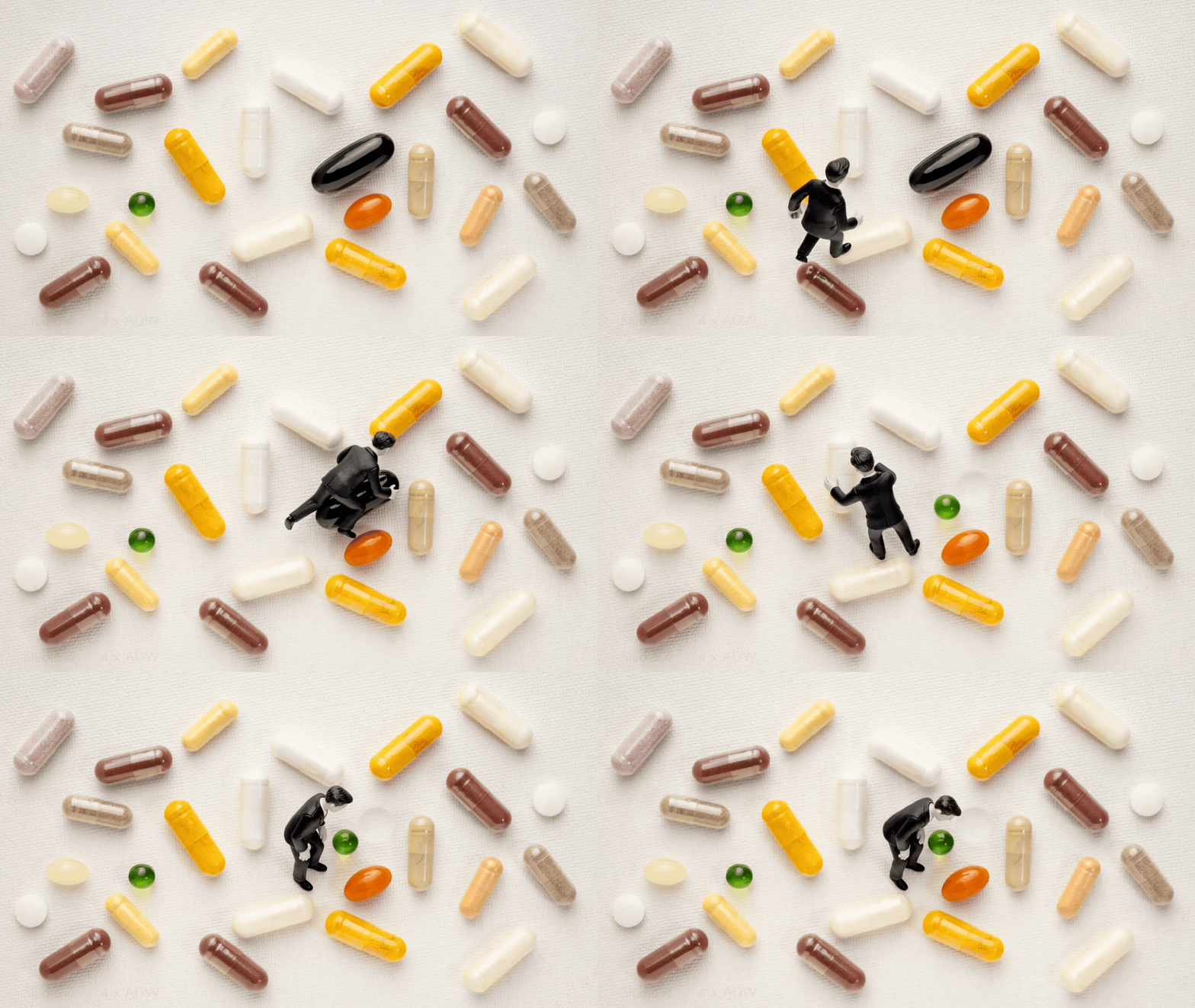
“Supplement Magic?” Animated Illustration by Studio4Null4
As Doberman advocates, we find it important to address an often misunderstood aspect of our dogs’ nutrition: supplementation. As a Doberman guardian, understanding the differences and overlaps between whole food-derived and synthetic supplements can help you make more informed choices for your dog’s long-term health.
In this article, we aim to clarify the differences between whole-food and synthetic supplements. We’ll look at where whole food-derived supplements may offer advantages, where well-formulated synthetic choices are appropriate, and why the overall diet should still matter most to you.
The Essence of Whole Food-Derived Supplements
Whole food-derived supplements are concentrated nutrients extracted from, for instance, foods like fruits, vegetables, meats, organs, and grains. They typically supply vitamins and minerals alongside naturally occurring compounds, such as phytonutrients, fibers, and enzymes, in a more complex matrix.
The possible advantages in comparison to their synthetic cousins are context and composition:
The nutrient matrix can determine how quickly or slowly a dog absorbs certain nutrients.
Depending on how they are processed, whole food concentrates can deliver a wider range of related compounds(for example, mixed carotenoids rather than only beta-carotene, or mixed tocopherols rather than a single vitamin E isomer).
Many of these compounds may have complementary or synergistic effects, even though the precise mechanisms in dogs, especially under particular, not average conditions, are not fully established.
Dobermans are, as we, their guardians, are well aware, vulnerable to certain cardiac, musculoskeletal, and metabolic issues. A carefully selected whole-food-derived supplement can help round out a diet over the long term, but addressing known gaps or higher demands during certain life stages may require a more precise approach.
Another issue with a simple categorization of whole-food versus synthetic supplements is that what appears to be a “whole-food” supplement at first glance may, chemically speaking, be synthetic.
Possibly to your surprise, not all marine omega-3 supplements are truly whole-food supplements. Many, if not most, products marketed simply as fish oil are, at the molecular level, modified or semi-synthetic forms of EPA and DHA (for example, ethyl esters or re-engineered concentrates) rather than minimally processed natural triglyceride oils. This situation is rarely obvious from the front of the bottle. What you actually want is a marine omega-3 supplement that provides EPA and DHA, ideally in a natural triglyceride or phospholipid matrix, with at least some of the native supporting lipids and antioxidants left intact, with tight control over oxidation, contaminants, and overall product integrity. Thus, in this comparative argument, the distinction is not as simple as “whole-food-derived” versus “synthetic,” because the way the raw materials and the oil are processed often matters more than the marketing label. (You can read more about omega-3 forms—TG, rTG, and ethyl esters—in our dedicated article on that topic here.)
Synthetic Supplements: A Cost-Effective and Often Appropriate Tool
Synthetic supplement manufacturing uses controlled chemical or fermentation processes, and the supplements are designed to provide specific, known amounts of individual nutrients, such as vitamin D3, B12, or iron.
This brings us to a few important clarifications:
For many vitamins, a bio-identical synthetic molecule (for example, L-ascorbic acid, the form of vitamin C) is chemically indistinguishable from the same molecule found in food, and human data show comparable bioavailability between food-derived and synthetic vitamin C.
For some nutrients, certain synthetic forms can be better studied or more stable, making them easier to dose accurately (for example, specific folate forms, some B vitamins, or chelated minerals).
Synthetic minerals are still the identical elements (Mg²⁺, Zn²⁺, etc.); what changes is the salt or chelate form and therefore absorption characteristics, not whether they are “natural” or “synthetic.”
Because they provide precise, concentrated doses, synthetic supplements can be extremely valuable when:
A specific deficiency has been documented.
A predictable therapeutic dose is needed.
Budget or availability make whole food concentrates unrealistic.
From a practical standpoint, many Doberman guardians may benefit from using a mix of both strategies over a dog’s lifetime: actual food combined with whole-food concentrates as simple dietary supplementation in a healthy dog. Synthetic supplements, when precise dosing is required to close a documented gap, support the dog during health challenges, or when cost is a factor.
Why Consider Whole Food-Derived Options When They’re Sensible?
Unlike some proponents of ‘all natural’ versus ‘not-natural’ approaches, the point is not that whole food-derived supplements are universally “better,” but that they often:
Deliver nutrients in physiological, food-like ranges instead of pharmacologic (mega)doses.
Provide them in the presence of cofactors and related compounds that would normally appear together in food.
May, in some cases, alter how quickly nutrients are absorbed in ways that benefit the system, even when core vitamin bioavailability is similar to that of synthetic versions.
For this reason, whole food-derived supplements can be useful as long-term support layered onto a precisely formulated diet, especially when the goal is steady nutrient coverage rather than aggressively correcting a specific deficiency.
What is important to realize is that claims that whole food supplements are always more bioavailable or that the body “recognizes them better” than bio-identical synthetic forms are oversimplifications. For some nutrients, such as vitamin C, data show similar bioavailability between whole food and synthetic forms. The added value of some, as shown not all, food-derived supplements is in the additional compounds, not in the vitamin molecule being “more real.”
Just as importantly, whole food-derived products are not automatically safer. Any supplement, natural or synthetic, can be dosed poorly, combined badly with medications, or used inappropriately for the dog’s clinical picture.
The Deciding Factors: Form, Dose, Context
Rather than “whole food vs. synthetic,” a more useful lens to apply may be:
Form
Is the nutrient in a form the body can readily use (for example, 5-MTHF vs. folic acid in certain scenarios, RRR-α-tocopherol vs. mixed isomers of vitamin E)?
For minerals, which salt/chelate is best for good absorption and tolerance in dogs?
Dose and ratio
Is the supplement providing a meaningful dose relative to the dog’s diet, size, and condition?
Purpose and duration
Is this a short-term, corrective intervention based on lab work, or a long-term, background support strategy?
Seen through that lens, a veterinarian prescribing a synthetic B12 injection to correct a documented deficiency and a whole-food-based trace mineral blend with listed, approximate nutritional values, not just an ingredient list or proprietary blend information, added to a raw diet can both be entirely rational, evidence-aligned decisions for the same Doberman at different points in time.
The Ideal: A Balanced, Nutrient-Dense Diet First
It’s worth noting that supplements, whether whole food-derived or synthetic, are what the name suggests: supplementary.
The foundation of your Doberman’s health is, despite supplements’ usefulness, still a diet that covers their nutritional needs as precisely as possible. Here, at a Doberman’s world, we advocate for fresh raw or gently cooked diets, but we are not anti-kibble and certainly against fear-based marketing. As such, for guardians practicing fresh raw feeding, this situation means:
Thoughtful rotation of muscle meats (without the faulty claim that rotation ensures balance and nutritional adequacy; balance and nutritional adequacy do not come from bare rotation but formulation),
Appropriate inclusion of edible raw meaty bone (always ground due to documented risk-benefit considerations),
Correct, measured inclusion of organs,
And, where used, carefully selected plant matter and components, rather than random add-ons based on lacking or cherry-picked evidence.
Then, again, even well-designed raw diets can have predictable weak spots, such as omega-3s, vitamin D, or trace minerals, depending on source and variety. Often, the dog is also the limiting factor. For example, sometimes you cannot add a certain food ingredient, or you need to add so much to close a known gap that a particular dog shows downstream GI symptoms, such as diarrhea. Those and other instances are also where supplementation, whether whole-food or synthetic, can be a helpful tool.
Final Thoughts
Navigating dog nutrition, especially for a breed as complex and health-challenged as the Doberman, is rarely about choosing a “team,” whole food, or synthetic. It’s about finding the right form, at the right dose, to the right dog, at the right time.
Whole-food-derived supplements can be a valuable way to add in broader nutrient families and cofactors to a diet, especially for long-term, rather than acute support.
Synthetic supplements, when thoughtfully selected and properly dosed, are equally legitimate tools, often with better data supporting precise dosing and deficiency correction, and they are frequently more cost-effective.
Ultimately, the best supplement is the one that:
Fits your Doberman’s actual clinical and nutritional status,
Integrates coherently with their overall diet,
Is safe and financially, as well as clinically, sustainable for you to provide.
Working with a veterinarian and, where appropriate, a nutrition professional who understands Dobermans and is comfortable with both whole-food-based and synthetic supplements will give you the broadest, most flexible toolkit for helping your dog thrive.
Disclaimer: The information provided in this article is for educational and informational purposes only and is not intended as a substitute for advice from your veterinarian or other healthcare professional. You should not use this information to diagnose or treat a health problem or disease or prescribe any medication or other treatment. Always consult with your veterinarian or other qualified healthcare provider before making any changes to your pet's healthcare regimen, especially if they have or suspect they may have a health problem. The author and publisher of this article are not responsible for any adverse effects or consequences resulting from the use of any suggestions, products, or procedures mentioned in this article. The use of this information is at the reader's discretion and risk.