Should Dog Owners Stop Reading Pet Food Ingredient Labels? Dr. Lisa Freeman, DCM, and the Bigger Pet Food Debate
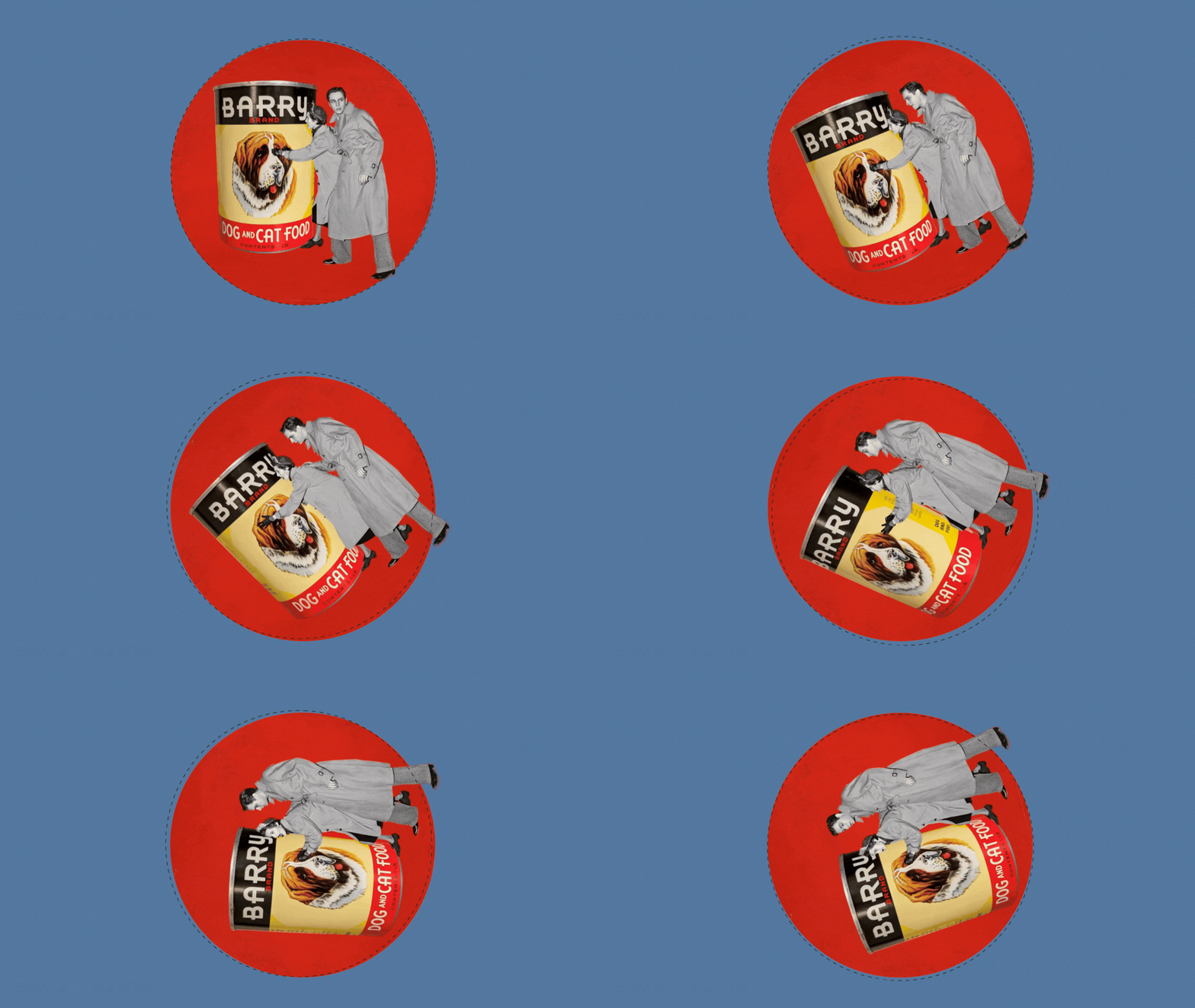
“Let’s find the Pet Food Label” Illustration by Studio4Null4
Recently, our attention has been drawn to a thought-provoking Facebook post by Dr. Conor Brady regarding Dr. Lisa Freeman, a veterinary nutritionist and professor at the Cummings School of Veterinary Medicine at Tufts University.
Dr. Freeman’s suggestions to not use pet food ingredient labels to judge which pet food to buy, has not only sparked considerable debate and criticism by Dr. Brady, but within the broader communities deeply concerned with pet nutrition.
What is most important to us here at ‘A Doberman’s World’ is that her input may also have influenced Doberman guardians’ purchasing decisions impacted by the Dilated Cardiomyopathy (DCM) controversy of 2018. Dr. Freeman was significantly involved into the DCM controversy through public-facing articles and professional commentary. Her commentary has intensified scrutiny of the prevailing pet diet recommendations with a strong tilt toward conventional pet foods. Today, caught in the middle of the larger debate, many Doberman owners may erroneously believe that their dogs should eat grain-inclusive diets and simply avoid grain-free diets without understanding the additional context of these recommendations.
How the DCM / Don’t Read The Pet Food Label Debate Developed
2013 → Dr. Lisa Freeman co-authors a JAVMA article on raw meat-based diets, helping establish her as a public voice in veterinary nutrition. The article, “Current knowledge about the risks and benefits of raw meat–based diets for dogs and cats” largely framed raw feeding through the lens of unsupported benefit claims and documented animal and public-health risks.
2018 → Diet-associated DCM becomes a major public concern, especially around grain-free, boutique, and exotic-ingredient diets, with Dr. Freeman’s 2018 writings helping shape and amplify that public framing.
June 2018 → Dr. Freeman publishes “A broken heart: Risk of heart disease in boutique or grain-free diets and exotic ingredients.” In that article, she warns about boutique, exotic-ingredient, and grain-free diets in the context of heart disease risk and tells pet owners to stop relying on ingredient lists when judging food. According to Dr. Freeman, the article reached “180,000 page views in the first” week alone.
2018 follow-up → The DCM framing continues through “Diet-associated dilated cardiomyopathy in dogs: What do we know?” and “It’s not just grain-free: An update on diet-associated dilated cardiomyopathy.” When Dr. Freeman said the concern was “not just grain-free,” she broadened the framing to what she called “BEG” diets: boutique companies, exotic ingredients, or grain-free diets. She pointed not only to grain replacements such as lentils and chickpeas, but also to exotic meats, vegetables, fruits, and possible differences in manufacturers’ nutritional expertise and quality control. Together, these 2018 pieces helped shape the public discussion around diet-associated DCM, especially the focus on boutique, exotic-ingredient, and grain-free diets.
2018–2019 → The term “BEG diets” (boutique companies, exotic ingredients, or grain-free) becomes widely circulated, and many dog owners begin treating “grain-free” as the central dietary risk.
2019 → Dr. Freeman publishes “Stop reading your pet food ingredient list!” In that article, she clarifies that she does read ingredient lists, but mainly to look for “red flags,” not to judge a food by appealing ingredients. She argues that ingredient lists are heavily shaped by marketing, do not show ingredient quality, and do not tell consumers whether nutrients are present in the right amounts or forms. Her examples of red flags include “fairy dust” ingredients used mainly for marketing, diets with too few ingredients to plausibly be complete and balanced, “all-natural” claims that may signal missing synthetic vitamins and minerals, and exotic ingredients such as kangaroo, bison, venison, chickpeas, or lentils, which she connects back to the ongoing diet-associated DCM investigation.
In the 2019 article, Dr. Freeman also links back to the Tufts Clinical Nutrition Team’s broader 2016 article, “Why you shouldn’t judge a pet food by its ingredient list.” That earlier piece was not limited to boutique or grain-free diets; it addressed ingredient-list marketing more generally, including problems such as ingredient splitting. However, that broader context does not erase the issue with the 2018 DCM framing, where the most visible scrutiny appeared to fall on boutique, exotic-ingredient, and grain-free diets rather than being applied evenly across the pet food market.
Public reaction → Critics argue that ingredient lists should not be dismissed, especially when scrutiny appears to fall more heavily on non-conventional pet food companies.
Conflict-of-interest concern →Dr. Freeman’s Petfoodology disclosure lists professional relationships, funding, lectures, or services connected to major pet food companies, including Hill’s, Purina, Mars/P&G, and Royal Canin.
Consumer impact → Doberman guardians, already concerned about breed-related DCM risk, may interpret the public messaging as “feed grain-inclusive conventional diets and avoid grain-free diets,” without enough context. The missing context is that “grain-free” became shorthand for a much broader set of questions: carbohydrate source, legume or pulse-heavy formulations, taurine and its precursors, fiber effects, processing, meat inclusion, company formulation practices, and breed risk.
The missing context became even more important in the later lawsuit. The complaint alleged that Dr. Freeman and Dr. Adin did not submit a representative sample of DCM cases to the FDA, but instead selected cases involving grain-free diets while withholding cases involving grain-containing diets. Those were allegations, not trial findings; they have not been proven in court, but they were also not disproven through a trial. Even as unresolved allegations, they help explain why a simple “avoid grain-free and feed grain-inclusive” takeaway may have given Doberman guardians an incomplete picture.
2024 → KetoNatural files a lawsuit against Hill’s Pet Nutrition and others connected to the DCM debate; Dr. Freeman is named in the original complaint, but the claims against her are later voluntarily dismissed.
November 2024 → The district court dismisses the case against Hill’s, finding that KetoNatural had not plausibly alleged commercial advertising or promotion under the Lanham Act, nor falsity.
2025–2026 → The appeal continues, and the broader debate remains unresolved: how should dog owners weigh ingredient lists, research funding, expert commentary, corporate influence, and actual diet quality?
The Full Controversy & Contentious Arguments
At this point you might ask yourself, what did the recommendation of not paying too much attention to the pet food label have to do with the DCM issue? That is a smart question to ask, and, here is what may surface when we strip down the timeline further.
DCM concern rises
→ grain-free, boutique, and exotic-ingredient diets are framed as suspect
→ owners are told ingredient lists are unreliable or overemphasized
→ conventional brands with veterinary research infrastructure look safer by comparison
→ many Doberman owners and even veterinarians reduce the issue to “avoid grain-free and choose grain-inclusive”
→ ingredient quality, formulation, processing, company conflicts, and broader diet context get pushed into the background
What you need to understand is that Dr. Freeman’s ingredient-label argument, and her later “fairy dust “ argument, appeared to focus mainly on non-conventional pet food ingredients or companies rather than applying the same level of scrutiny across the entire pet food market. In her widely circulated 2018 article,“A broken heart: Risk of heart disease in boutique or grain-free diets and exotic ingredients”, she later stated that she had advised readers to “Stop reading your pet food ingredient list!” and acknowledged receiving criticism for that recommendation. That 2018 article focused on boutique, exotic-ingredient, and grain-free diets. In 2019, in “Stop reading your pet food ingredient list!,” she continued that line of argument by highlighting “fairy dust” ingredients in non-conventional pet foods. She also linked from the 2019 article to a broader 2016 Tufts Clinical Nutrition Team article, “Why you shouldn’t judge a pet food by its ingredient list,” which was not limited to boutique pet foods but addressed ingredient-list marketing more generally. Still, the broader position risks oversimplifying a complex issue, especially because the earlier 2018 framing appeared to direct the sharpest scrutiny toward non-traditional companies and ingredients. In our opinion, Dr. Freeman failed to apply the same visible scrutiny to ingredients used by companies listed in her disclosure, especially in her widely circulated 2018 pieces that were the main public-facing drivers for the DCM controversy.
After all, Dr. Freeman was one of the named defendants in the grain-free/DCM related lawsuit until the plaintiff voluntarily dismissed the claims against her. Approximately six years after the grain-inclusive versus grain-free diet and DCM controversy began, Dr. Freeman faced legal challenges connected to the grain-free DCM issue. The 2024 lawsuit originally named Dr. Freeman and several other veterinarians. Although KetoNatural, the plaintiff, later voluntarily dismissed the claims against Dr. Freeman, her inclusion in the original complaint still reflects how complex and sensitive pet nutrition advice had become after the DCM controversy. It also shows how much influence expert figures can have on pet owners’ choices and veterinary recommendations.
Financial David versus Goliath
And the framing did not stop there. In some ways, it had already been prefaced. Once pet owners are told not to focus too closely on ingredient lists, the next question becomes: what are they supposed to rely on instead?
In the ongoing debate over pet nutrition, that question cannot be separated from the influence of large, conventional pet food companies. These corporations market their products extensively and sponsor much of the research used to support their claims. That relationship between commercial interests and scientific research can create a significant conflict of interest and may skew the information consumers receive.
This matters even more when the same broader conversation intersects with the grain-free and DCM issue. If boutique, exotic-ingredient, and grain-free diets are placed under intense scrutiny, while conventional companies are positioned as the safer, more research-backed default, then the structure of the marketplace itself becomes part of the problem.
Market research also suggests that a few brands dominate the veterinary diet market, with Hill’s Pet Nutrition, owned by Colgate-Palmolive, and Royal Canin, owned by Mars, collectively holding approximately 75–80% of the U.S. veterinary diet market value. In that context, Dr. Freeman’s 2016 recommendation that “savvy owners” ask whether a pet food company conducts research and publishes it in peer-reviewed journals becomes quite an interesting suggestion.
Conducting that kind of research requires substantial funding. As a result, this recommendation may add another layer that favors large, conventional pet food companies while disadvantaging smaller manufacturers that lack those resources, including many boutique pet food companies. That does not automatically make smaller companies better or larger companies worse. However, it does mean that the advice to look for published research does not land in a neutral marketplace, especially when, as mentioned earlier, Dr. Freeman discloses her professional relationships with Hill’s, Purina, Mars/P&G, and Royal Canin.
Goliath’s Dynamics
The dynamic between large companies and their professional affiliations creates a challenging environment for pet owners trying to make informed decisions about their pets’ nutrition. While large pet food companies have the resources to produce quality foods, the potential bias introduced by research sponsorship or affiliations with the people educating the public about diets and nutrition can make it difficult for consumers to distinguish between marketing and genuine nutritional advice.
Addressing conflicts of interest, whether in research or in public-facing opinions like Dr. Freeman’s, is crucial for ensuring that pet owners, including Doberman parents, have access to reliable information. By recognizing the role of marketing, sponsored research, and other professional engagements in shaping perceptions of pet food, consumers can better navigate the complex landscape of pet nutrition and make choices that are genuinely in the best interest of their pets’ health and well-being. More prominent transparency from science communicators and pet food companies regarding research sponsorship, professional affiliations, and marketing practices would be a significant step forward in building trust with consumers and fostering a more informed and objective discussion about pet food nutrition.
So What Does All That Mean? Should You Read Pet Food Labels?
Yes, despite a few valid points Freeman made, the importance of scrutinizing pet food ingredients should not be dismissed outright.
While we agree with Dr. Freeman on some issues, we disagree with limiting the conversation to BEG diets. Some of the points Dr. Freeman makes about companies marketing their products by highlighting specific ingredients, claiming superior nutritional benefits, or failing to clearly explain the actual nutritional value those ingredients provide in the final product are, in our view, valid. We also agree that the label is not everything when judging a pet food’s nutritional adequacy. However, the conversation around pet food, often sparked by Dr. Freeman’s public commentary, should apply to every pet food company, including the ingredients used in products made by companies with which Dr. Freeman has disclosed professional associations. Ingredient lists should be scrutinized regardless of who produced the food, and they should be considered alongside the broader context in which pet food research and marketing occur. Consumers should be aware of potential conflicts of interest and encouraged to seek out a diverse range of information sources, including independent studies, unbiased veterinary feedback, and reputable third-party reviews.
As mentioned, Dr. Freeman linked to a broader 2016 article from the Clinical Nutrition Team at Tufts called “Why you shouldn’t judge a pet food by its ingredient list,” which addressed pet food ingredient marketing on a larger scale. In that article, Tufts’ Clinical Nutrition Team took the position that ingredient splitting can make ingredient lists problematic, and we agree with that statement. However, unlike Dr. Freeman, who seems to suggest that ingredient lists should be de-emphasized, we believe ingredients do matter. They are the building blocks of the nutrition we provide to our pets, regardless of who produces the product. People should learn how to read an ingredient list and then use it as one evaluation point within all the information available about a pet food. To us, the contention arises when companies market ingredients, conventional or non-conventional, to appeal to pet owners independent of the actual nutritional value those ingredients provide.
Lawsuit Update 2026:
District court dismissed the case in November 2024.
Judge Kathryn Vratil dismissed the claims in November 2024, finding that KetoNatural had not plausibly alleged that the challenged statements constituted commercial advertising or promotion under the Lanham Act, and also had not plausibly alleged falsity.
KetoNatural appealed to the Tenth Circuit.
The appeal is KetoNatural Pet Foods v. Hill’s Pet Nutrition, No. 24-3185, filed December 4, 2024.
Oral argument happened November 20, 2025.
Courthouse News covered the argument and noted KetoNatural asked the Tenth Circuit to revive the false-advertising suit.
As of April 11, 2026, no Tenth Circuit opinion had been issued.
A Corporate and Business Law Journal article reported on the Tenth Circuit’s November 20, 2025 oral argument and stated that the court had, “to date,” “not authored an opinion yet.”
As of July 3, 2026, publicly accessible docket summaries and legal commentary we found do not show a Tenth Circuit opinion resolving the appeal.
Article last updated: 2026, July
Additional Arguments about Ingredient List Reading:
LEARN HOW TO READ INGREDIENT LABELS (Dr. Judy Morgan)
INGREDIENT LABELS Part 1 (Dr. Karen Becker)
INGREDIENT LABELS Part 2 (Dr. Karen Becker)
INGREDIENT LABELS Part 3 (Dr. Karen Becker)
Note: We are neither affiliated, nor endorse Dr. Judy Morgan or Dr. Karen Becker. We simply aim to offer additional arguments about ingredient label reading.
Article last updated: May 3, 2026
In-Text Linked References
Brady, C. (2024, March 17). Stop reading the ingredients!!! Said no human food consumer ever ...Have you heard this one yet from your favourite Purina [Facebook post]. Facebook. https://www.facebook.com/DogsFirstIreland/posts/pfbid03698zns2pFX5AmQAC1ZM2FtJPfYahHRDoTwzgco6vFtPw4DpBKhshasMzviduTB4el
Clinical Nutrition Team. (2016, June 21). Why you shouldn’t judge a pet food by its ingredient list. Petfoodology. https://sites.tufts.edu/petfoodology/2016/06/21/why-you-shouldnt-judge-a-pet-food-by-its-ingredient-list/
Expert Market Research. (2026). United States pet veterinary diet market size and share. MarketResearch.com. https://www.marketresearch.com/Expert-Market-Research-v4220/United-States-Pet-Veterinary-Diet-44619725/
Freeman, L. M. (2016, December 19). Questions you should be asking about your pet’s food. Petfoodology. https://sites.tufts.edu/petfoodology/2016/12/19/questions-you-should-be-asking-about-your-pets-food/
Freeman, L. M. (2018, June 4). A broken heart: Risk of heart disease in boutique or grain-free diets and exotic ingredients. Petfoodology. https://sites.tufts.edu/petfoodology/2018/06/04/a-broken-heart-risk-of-heart-disease-in-boutique-or-grain-free-diets-and-exotic-ingredients/
Freeman, L. M. (2018, November 29). It’s not just grain-free: An update on diet-associated dilated cardiomyopathy. Petfoodology. https://sites.tufts.edu/petfoodology/2018/11/29/dcm-update/
Freeman, L. M. (2019, March 1). Stop reading your pet food ingredient list! Petfoodology. https://sites.tufts.edu/petfoodology/2019/03/01/stop-reading-your-pet-food-ingredient-list/
Freeman, L. M., Chandler, M. L., Hamper, B. A., & Weeth, L. P. (2013). Current knowledge about the risks and benefits of raw meat–based diets for dogs and cats. Journal of the American Veterinary Medical Association, 243(11), 1549–1558. https://doi.org/10.2460/javma.243.11.1549
Freeman, L. M., Stern, J. A., Fries, R., Adin, D. B., & Rush, J. E. (2018). Diet-associated dilated cardiomyopathy in dogs: What do we know? Journal of the American Veterinary Medical Association, 253(11), 1390–1394. https://doi.org/10.2460/javma.253.11.1390
Freeman, L.M. (2026, March 6 ). Who we are. Petfoodology. https://sites.tufts.edu/petfoodology/2026/03/06/who-we-are/
KetoNatural Pet Foods, Inc. v. Hill’s Pet Nutrition, Inc., 756 F. Supp. 3d 1125 (D. Kan. 2024). https://www.govinfo.gov/app/details/USCOURTS-ksd-2_24-cv-02046
KetoNatural Pet Foods, Inc. v. Hill’s Pet Nutrition, Inc., 756 F. Supp. 3d 1125 (D. Kan. 2024). https://www.govinfo.gov/content/pkg/USCOURTS-ksd-2_24-cv-02046/pdf/USCOURTS-ksd-2_24-cv-02046-1.pdf
KetoNatural Pet Foods, Inc. v. Hill’s Pet Nutrition, Inc., No. 24-3185 (10th Cir. filed Dec. 4, 2024). Justia Dockets & Filings. https://dockets.justia.com/docket/circuit-courts/ca10/24-3185
McClung, M. (2026, April 11). When the dog food fights back: A false advertising feud between two dog food companies. Corporate and Business Law Journal. https://cablj.org/when-the-dog-food-fights-back-a-false-advertising-feud-between-two-dog-food-companies/
Pampuro, A. (2025, November 20). 10th Circuit asked to bite into natural dog food feud. Courthouse News Service. https://www.courthousenews.com/10th-circuit-asked-to-bite-into-natural-dog-food-feud/
Thixton, S. (2024, February 9). Lawsuit claims Hill’s Pet Food and veterinarians fabricated grain-free diet scare. Truth about Pet Food. https://truthaboutpetfood.com/lawsuit-claims-hills-pet-food-and-veterinarians-fabricated-grain-free-diet-scare/
Disclaimer: The information provided in this article is for educational and informational purposes only and is not intended as a substitute for advice from your veterinarian or other healthcare professional. You should not use this information to diagnose or treat a health problem or disease or prescribe any medication or other treatment. Always consult with your veterinarian or other qualified healthcare provider before making any changes to your pet's healthcare regimen, especially if they have or suspect they may have a health problem. The author and publisher of this article are not responsible for any adverse effects or consequences resulting from the use of any suggestions, products, or procedures mentioned in this article. The use of this information is at the reader's discretion and risk.