History of the Doberman Pinscher
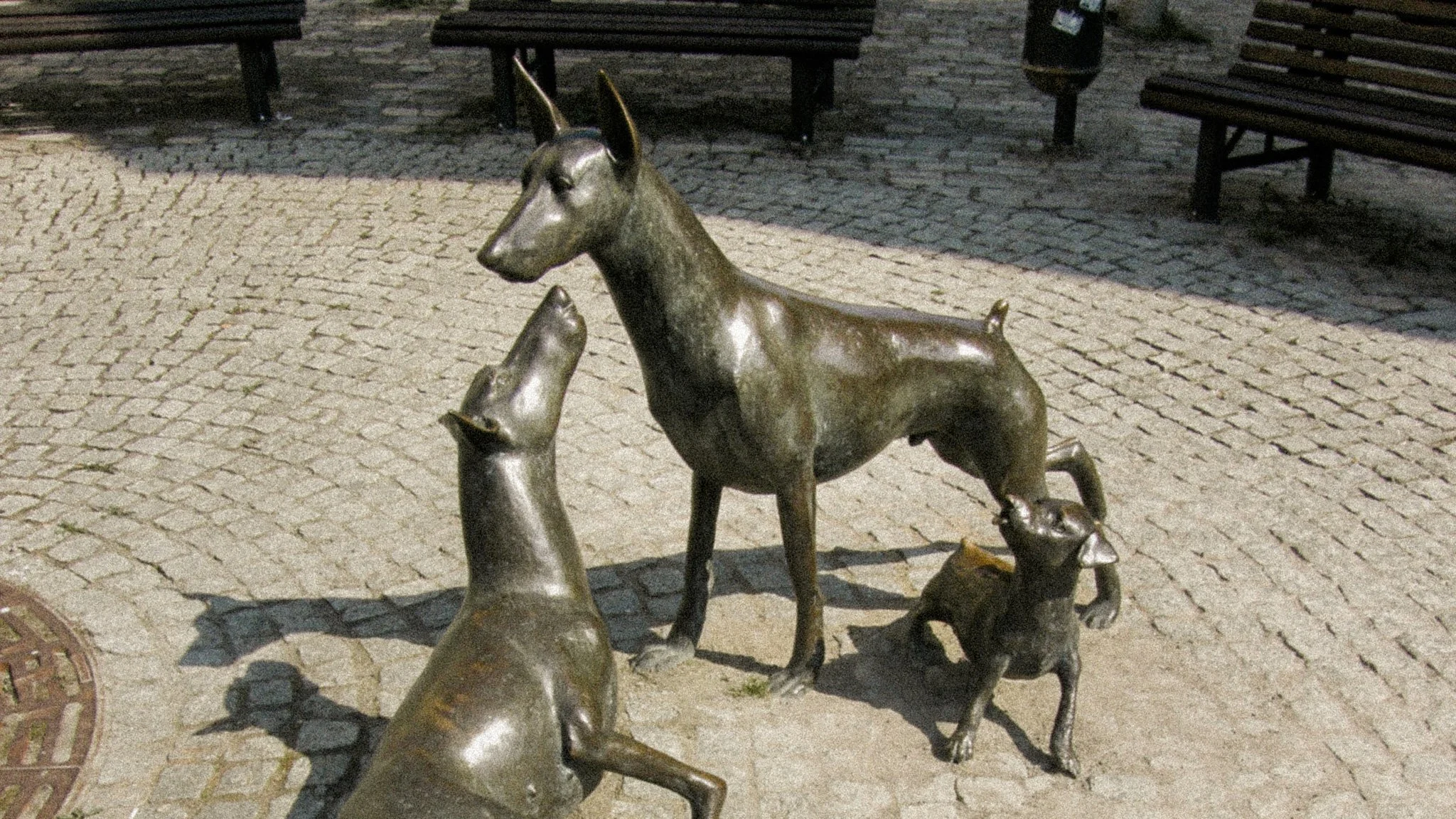
Image: Dobermann Denkmal, Apolda, Germany. Credit: Original photo by NatiSythen. Modified with color/filter adjustments and cropped.
The Undauntd Guardian: Tracing the Origins of the Doberman Pinscher
Call us biased, but in the annal of canine history, few breeds boast as distinguished and purposeful an origin as the Doberman Pinscher. Most people know them for their sleek coat, athletic build, and vigilant demeanor, and they are synonymous with protection and loyalty to their people. But where did our admired breed originate, and what was the impetus behind its creation? Let's delve into the history of the Doberman Pinscher, tracing its roots back to the late 19th century in Germany.
The Visionary: Karl Friedrich Louis Dobermann
The breed owes its name and inception to Karl Friedrich Louis Dobermann of Apolda. His documented working life was varied. Official Apolda documents from 1871 and the 1880s identify him as a night watchman; in 1871, precisely the time when he started breeding the early Dobermänner, his occupation is given more specifically as Nachtpolizist, or night policeman. He also appears at least twice as a Wirker, which is a worker in Apolda’s textile industry, and as the only Kaviller listed for the town. Kaviller was an older term for an Abdecker, someone responsible for removing and processing animal carcasses. The Kaviller job was, as reported elsewhere in historical accounts, likely also related to duties of catching alive dogs. These occupations brought Dobermann into contact with dogs, and gave him practical reason to value a reliable protective companion, particularly while working at night. The familiar claim that he was also a tax collector is questionable. No contemporary evidence supporting it has yet been located, and the City of Apolda does not include tax collector among the occupations in its own account of his life. We are currently investigating where the claim originated and will update this article if further documentation comes to light. (Please see editorial note at the bottom of this article)
However, a lesser know fact is that Doberman also had a financial incentive to continue breeding dogs because, at the time, farmers in the surrounding areas had issues with burglaries. The farmers had heard of the Dobermannschen Hunde and soon became interested in acquiring the dogs to protect themselves.
Moreover, the Doberman was also dubbed ‘Gendarmenhund’ because the police became quite fond of the early version of the breed.
The Creation of a Breed
With access to a diverse gene pool of dogs, Dobermann embarked on a breeding program around the 1870s (commonly misidentified as the 1890s) to develop a breed that would be the perfect protector. He sought to combine intelligence, strength, faithfulness, ferocity, and a keen sense of smell. Although Dobermann's exact breeds he used remain a matter of speculation, it is widely believed that the Rottweiler, German Pinscher, Weimaraner, and the old German Shepherd breed were among the primary contributors. Some accounts also suggest that the Greyhound and Manchester Terrier were included to refine the breed’s agility and appearance, respectively. Moreover, several people, most notably Otto Goeller and subsequently Dr. Emil Hauck, believed that Doberman crossbred the Great Dane, likely for its strength.
The Breed Evolves
After Karl Dobermann died in 1894, the breed continued to be refined by other breeders. The most notable among them was Otto Goeller, who significantly developed the breed standards and promoted the Doberman as a distinct breed. On August 27th, 1899 he also founded the first Doberman Club in Apolda. Goeller's efforts led to stabilizing the breed traits, emphasizing physical prowess, intelligence, and temperament.
In 1895, the Doberman Pinscher, in Germany at the time ‘Dobermannpinscher,’ was recognized as a breed, having previously been referred to simply as the Dobermann. This development is often attributed to breeder Goswin Tischler. According to the Dobermann-Verein, the breed’s first exhibition followed in 1898. However, Ria Hörter states that the first Dobermanns were reportedly seen at an exhibition in Erfurt in 1897, and that the first Spezialzuchtschau was organized in 1899 with 12 Dobermanns. We are currently investigating the 1897 Erfurt exhibition through surviving contemporary archival records and will update this account as further evidence becomes available. (Please see editorial note at the bottom of this article)
The Doberman Pinscher’s Global Journey
The breed's reputation for intelligence, owner devotion, and protective instincts quickly spread beyond Germany. During World War I and II, Dobermans were employed extensively as war dogs, serving as messengers, scouts, and sentinels. This exposure cemented their status as versatile and reliable working dogs. By the mid-20th century, the Doberman Pinscher had gained a formidable reputation, and its popularity soared in the United States and worldwide.
The Modern Doberman: A Family Companion and Protector
Today's Doberman Pinschers have been bred with a greater focus on temperament, resulting in a less aggressive breed and more suited to family life than its early ancestors. The American Kennel Club (AKC) describes them as fearless, watchful, and obedient, making them highly sought after for work and companionship.
Nobility, Strength, and Dedication
The origin of the Doberman Pinscher is a testament to the vision of Karl Friedrich Louis Dobermann and the breeders who followed him. From the streets of 19th-century Germany to modern homes and workplaces around the world, the Doberman has evolved into a symbol of nobility, some even say ‘elitism’, strength, and dedication. Our breed's journey from a protector to a mainly beloved family member was the logical evolution of a dog that develops a profound bond to their humans, a relationship built on mutual respect and loyalty.
As we appreciate the sleek silhouette and vigilant gaze of a Doberman Pinscher, we feel reminded of the breed’s unique heritage and the enduring legacy of its founder, Karl Dobermann. The Doberman Pinscher stands as an aristocratic guardian, a testament to the power of purposeful breeding and the enduring appeal of this faithful breed.
Editorial Note & Correction, August, 16th, 2026: Original text published: ‘The breed owes its name and inception to a German tax collector, Karl Friedrich Louis Dobermann. Living in the town of Apolda in the Thuringian region during the late 1800s, Dobermann also served as a night watchman and ran the local dog pound. His multifaceted career exposed him to the dangers of bandits and thieves, fueling his desire for a formidable canine companion that could ensure his safety during his tax collection rounds and at night.‘
Correction, August 16th, 2026: The breed owes its name and inception to Karl Friedrich Louis Dobermann of Apolda. His documented working life was varied. Official Apolda documents from 1871 and the 1880s, precisely the time when he started breeding the early Dobermänner, identify him as a night watchman; in 1871, his occupation is given more specifically as Nachtpolizist, or night policeman. He also appears at least twice as a Wirker, which is a worker in Apolda’s textile industry, which is a worker in Apolda’s textile industry, and as the only Kaviller listed for the town. Kaviller was an older term for an Abdecker, someone responsible for removing and processing animal carcasses. The Kaviller job was, as reported elsewhere in historical accounts, likely also related to duties of catching alive dogs. These occupations brought Dobermann into contact with dogs and gave him practical reason to value a reliable protective companion, particularly while working at night. The familiar claim that he was also a tax collector is questionable. No contemporary evidence supporting it has yet been located, and the City of Apolda does not include tax collector among the occupations in its own account of his life. We are currently investigating where the claim originated and will update this article if further documentation comes to light.
Editorial Note & Correction, August, 16th, 2026: Original text published:
‘In 1895, the the Doberman Pinscher (in Germany at the time ‘Dobermannpinnscher’) was recognized as a breed (formerly only referred to as Dobermann), a success that is often attributed to the breeder Goswin Tischler, and in 1898 followed the breed’s first exhibition, although, according to Ria Hörter, the first Spezialzuchtschau was organized in 1899 with 12 Dobermanns.’
Correction, August 16th, 2026: In 1895, the Doberman Pinscher, in Germany at the time ‘Dobermannpinscher,’ was recognized as a breed, having previously been referred to simply as the Dobermann. This development is often attributed to breeder Goswin Tischler. According to the Dobermann-Verein, the breed’s first exhibition followed in 1898. However, Ria Hörter states that the first Dobermanns were reportedly seen at an exhibition in Erfurt in 1897, and that the first Spezialzuchtschau was organized in 1899 with 12 Dobermanns. We are currently investigating the 1897 Erfurt exhibition through surviving contemporary archival records and will update this account as further evidence becomes available.