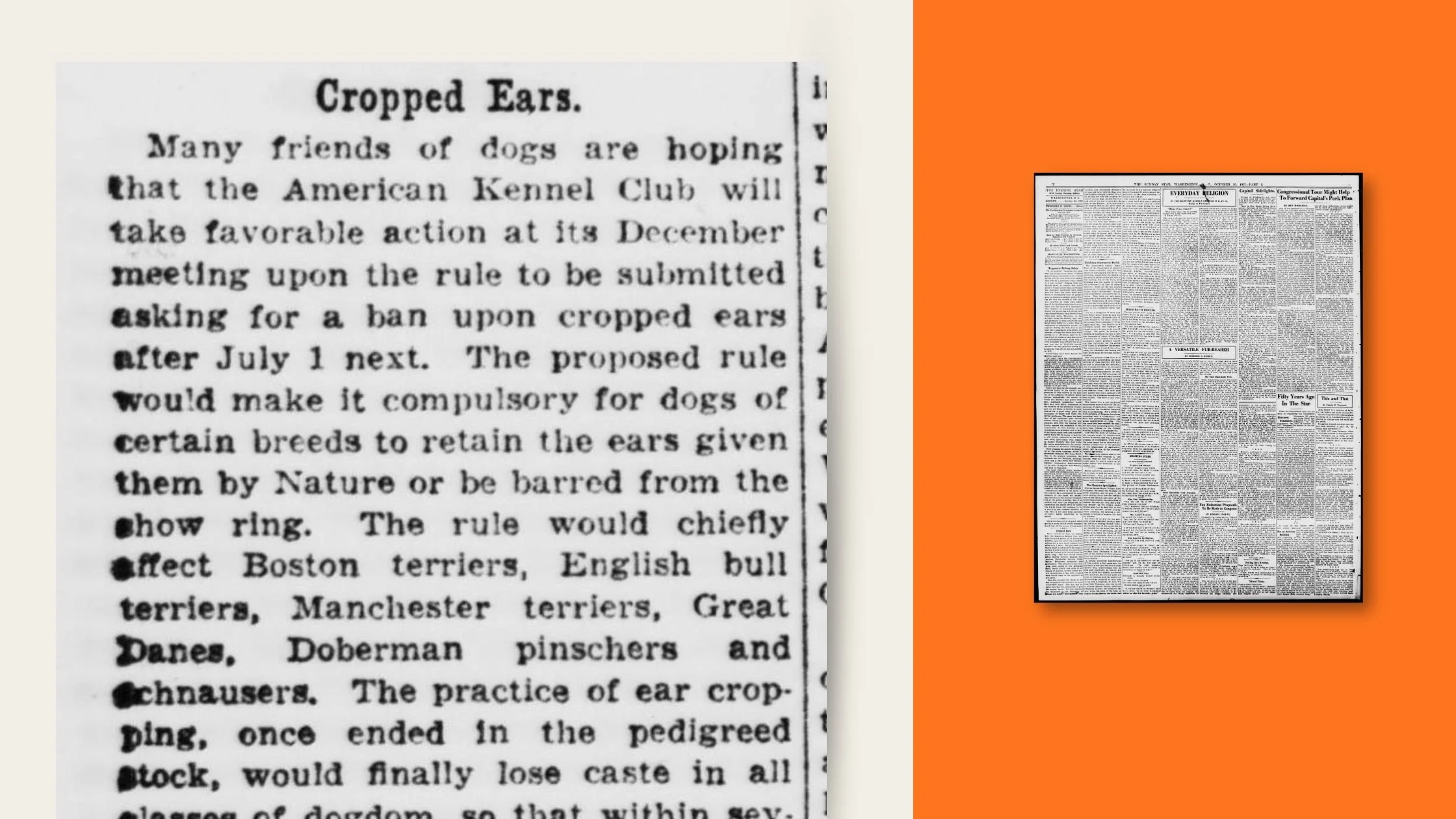
In October 1927, The Sunday Star published the following editorial in support of a proposed AKC ban on cropped ears in the show ring.
“Cropped Ears
Many friends of dogs are hoping that the American Kennel Club will take favorable action at its December meeting upon the rule to be submitted asking for a ban upon cropped ears after July 1 next. The proposed rule would make it compulsory for dogs of certain breeds to retain the ears given them by Nature or be barred from the show ring. The rule would chiefly affect Boston terriers, English bull terriers, Manchester terriers, Great Danes, Doberman pinschers and Schnauzers. The practice of ear cropping, once ended in the pedigreed stock, would finally lose caste in all classes of dogdom, so that within several generations a dog with cropped ears would come to be regarded as mutilated.
Man has changed the shape of the dog throughout the centuries in many remarkable ways. The dog has become thin, like the greyhound, to give his master speed. He has assumed the smallness of the Pekingese to please the ladies. Not satisfied with breeding such remarkable divergence of type and form into his dogs, man has foolishly thought to better Nature by docking the tails and cropping the ears of certain dogs, notably the ears and tails of the bull terriers and the ears of the Bostons. It is true that the cropped ears of the latter breed seem to add a certain cockiness of expression to these dogs that strikes the average beholder as most becoming; but it is probably no less true that much of the spectator’s pleasure is simply the result of custom.
If the best bred dogs should come into the rings for several years with natural ears, the fancy of the public in this regard would change, so that before long upstanding, stiff ears would begin to appear ugly. Mutilation among human beings has long passed out of custom except among certain uncouth savage tribes. Let the dogs of civilization remain, then, as they come from the hand of their Maker—with lop ears if their ears be loppy, with upstanding ones if their ears be naturally erect. The fault is not in their ears, but in ourselves, that we do hold them ugly.
—“Cropped Ears,” The Sunday Star, Washington, D.C., October 30, 1927, p. 2.”
ADW Editors Note: line-break hyphenation was removed for readability. Historical writing reproduced for research, context, and the preservation of Doberman history.
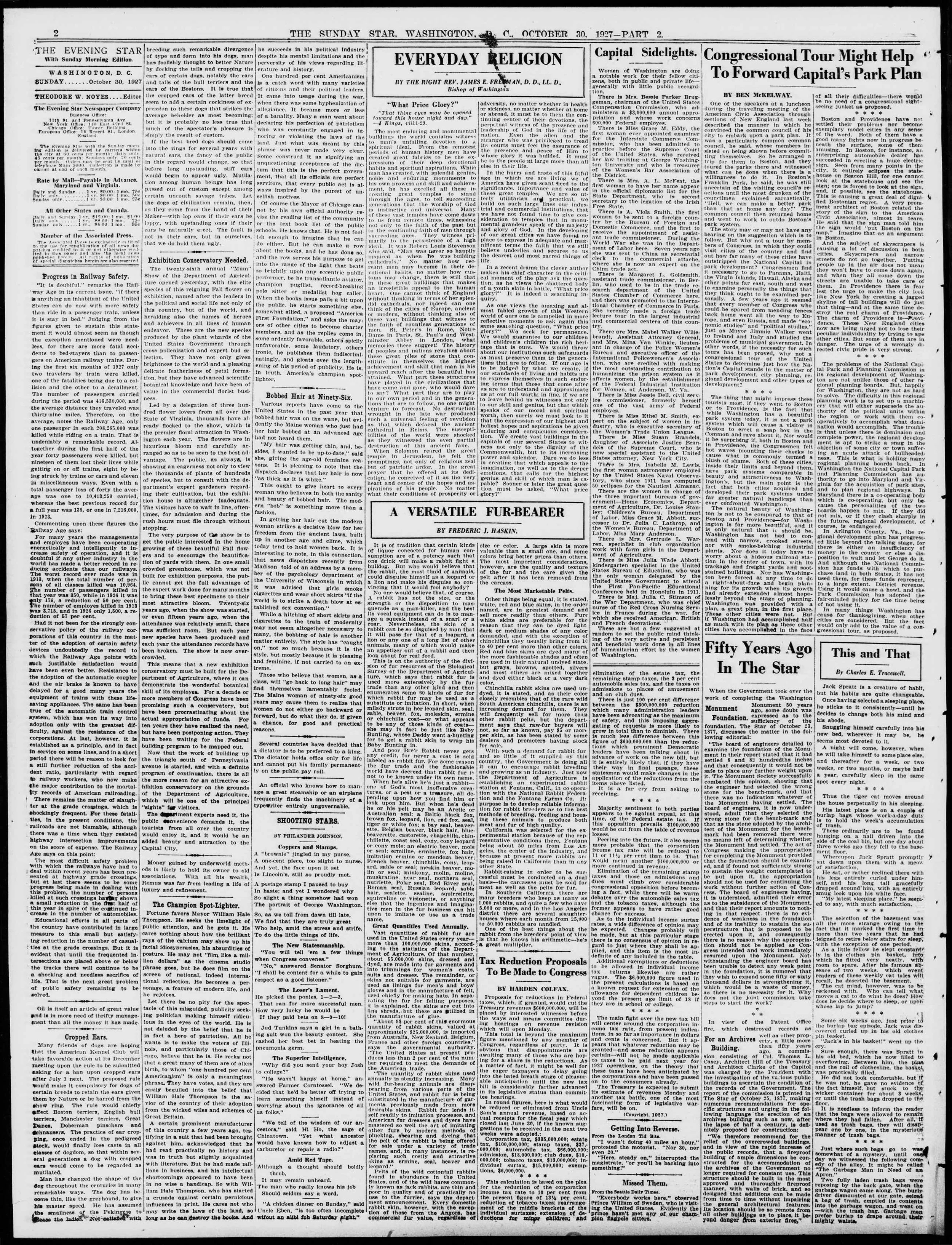
View the complete original newspaper page (PDF)
A Brief Discussion
Read nearly a century later, the editorial feels unexpectedly current. Its central claim is that public taste follows what the show ring rewards. Allow natural ears to become familiar, the writer argues, and cropped ears will eventually appear strange. That assigns kennel clubs and breed standards considerable power over what the public comes to recognize as the proper silhouette of a breed.
Breed history rarely arrives in a morally tidy package. A standard preserves a recognizable type while carrying forward the decisions of those who shaped it. Later generations inherit the whole record. The 1927 writer was confident that ending ear cropping would allow custom to correct itself. Almost a century of continued disagreement suggests that a breed’s form cannot be separated quite so easily from its history.
Editorial Update, August 19, 2026
Other contemporary editorials, published later that same year, shows that the argument had already reached the American Kennel Club itself.
On December 9, 1927, a Los Angeles Times editorial reported that the AKC Rules Committee had adopted an anti-cropping resolution under which no dog born after July 1, 1928 could be exhibited with cropped ears at an AKC show. The Westminster Kennel Club had instructed its delegate to vote in favor of the resolution.
On December 17, 1927, The Philadelphia Inquirer reported that the AKC had failed to secure the required majority for a resolution that would have made dogs born after the following July ineligible for exhibition if their ears had been cropped. The article described the defeat as leaving the issue “to the specialty clubs and to the humane legislation of various States.”
The debate did, in fact, move in that direction. Within the following two years, state legislation affecting ear cropping and the exhibition or possession of cropped dogs appeared in several states, and the AKC was warning Doberman owners about restrictions in New York, Connecticut and Massachusetts by 1929.
We are continuing to research this legislation, its enforcement, and its effect on dog shows. We will treat that history separately in the Archive together with the associated primary-source material, including newspaper clippings, show notices, legislative records, ephemera, and other contemporary material.