
Published in 1922, the same year the newly formed Doberman Pinscher Club of America adopted the German breed standard, A. F. Hochwalt’s account in Dogs as Home Companions (1922) records how one American dog writer understood a breed that was still establishing its identity in the United States:
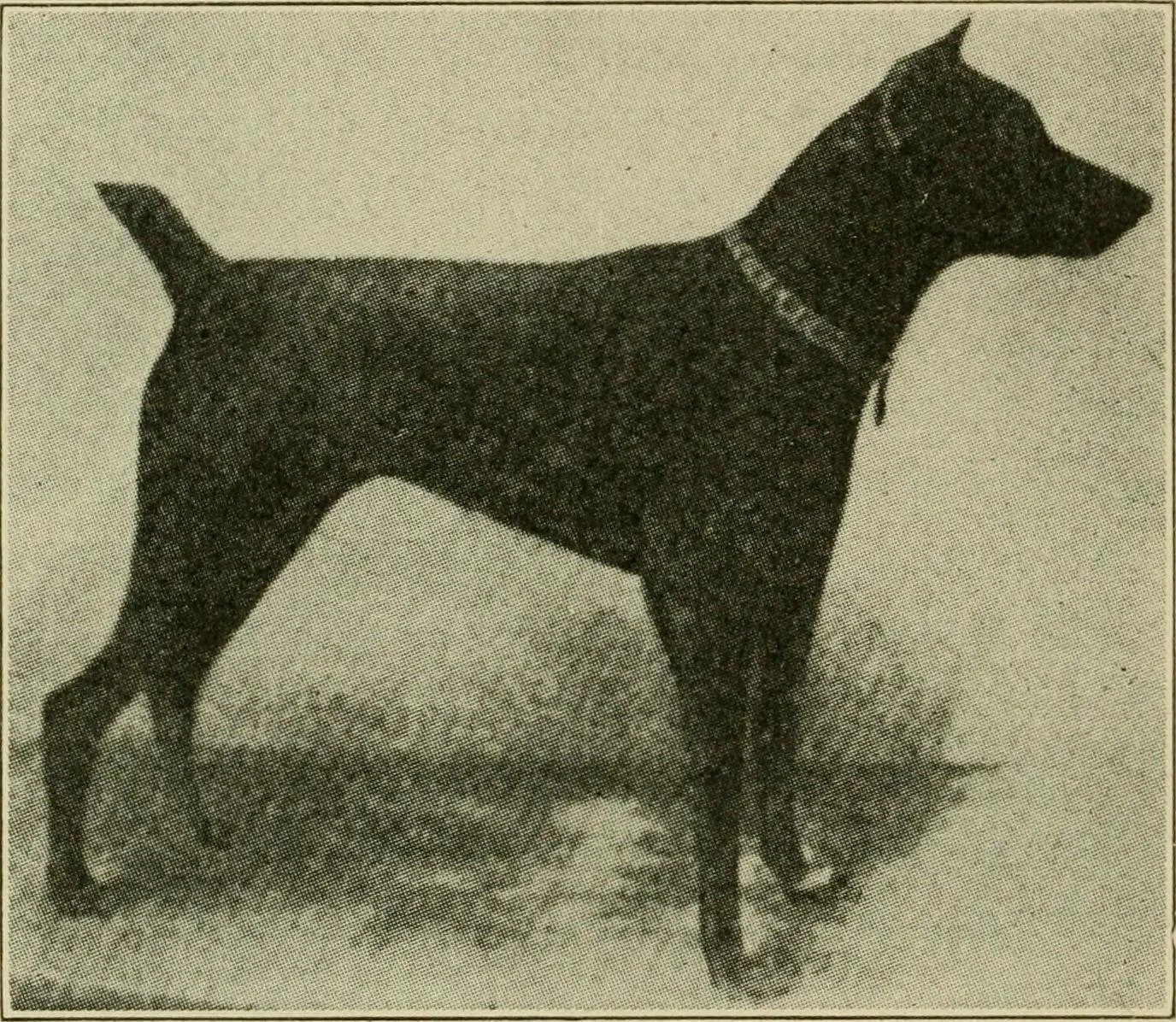
Ch. Betel Doberman in A. F. Hochwalt’s Dogs as Home Companions (1922), where the photograph precedes Hochwalt’s profile of the breed. Courtesy of the Library of Congress and Internet Archive Book Images via Wikimedia Commons.
THE DOBERMAN PINSCHER CH. BETEL DOBERMAN.
The Doberman Pinscher, which is really a terrier possessing characteristics of the Airedale, is another dog which, when he once becomes fully known and appreciated for his sterling qualities, will become a more general home favorite. He is smooth coated, prick-eared and black and tan in color, weighing in the neighborhood of thirty-five to forty pounds. He is very intelligent and is as easily taught to perform the duties of an allround “varmint dog” as any breed in existence. As a police dog he is said to be even more readily trained than the breed which is supposed to be a specialist in that sphere—namely the shepherd dog—until lately known as the German or Belgian shepherd dog.
While on the subject of the latter breed, it might be said in passing, that this dog is gaining in popularity each year. He is said to be intelligent, in fact he is easily trained, but here also is a breed which is somewhat uncertain in temper despite the stories to the contrary. As a watch dog he cannot be surpassed. For those having country estates or large enough out-door space, this dog is a very desirable one, but it is scarcely possible to keep one of these in limited quarters.
The same may be said of any of the larger breeds, and as this book is devoted to the dogs that are suitable for the large towns and cities we shall refer the aspiring fancier who is bent upon going in for the large dogs to procure a copy of “Dogcraft,” a former work of mine which gives the standards of all breeds, large and small.
—A. F. Hochwalt, Dogs as Home Companions: A Book for All Dog Lovers, Cincinnati, Ohio: Sportsman’s Digest, 1922, pp. 65–66.
ADW Editors Note: Hochwalt was an established authority, but Dogs as Home Companions was one of his popular general-interest books rather than a central work of canine scholarship. However, science educator Hanor A. Webb included Dogs as Home Companions in his 1925 in his selected science-library list for American high schools.
A Brief Discussion
First, the photograph accompanying Hochwalt’s account, shared above, should not be taken as representative of the breed in 1922. The same portrait had appeared in the 1911 Breeders’ and Exhibitors’ of Dogs Guide Book and Directory, where Betel was identified as an imported champion owned by Doberman Kennels, Inc., of Rochester, New York. Hochwalt was illustrating his discussion with a photograph already at least eleven years old.

Ch. Betel Doberman in the 1911 Breeders’ and Exhibitors’ of Dogs Guide Book and Directory, where the photograph precedes A. F. Hochwalt’s republishing in his 1922 portrait about the breed.
Also, Hochwalt’s 35-to-40-pound Doberman requires a historical footnote. The first German standard, issued in 1899, gave an approximate weight of 44 pounds and allowed males from roughly 21¾ to 24½ inches at the shoulder. The Doberman Pinscher Club of America records that it adopted the official German standard on February 13, 1922. The DPCA’s version of the 1920 German standard survives in American publications from 1925, 1926 and 1929. It placed males between approximately 22¾ and 25½ inches and specified no weight. Together with the approximate 44-pound weight in the 1899 standard, it places Hochwalt’s 35-to-40-pound estimate in context: Dobermans were smaller at the time, but his figure should not be read as the breed’s average weight in 1922.
The Airedale comparison becomes more interesting once Hochwalt’s own background enters the picture. He had written The Airedale for Work and Show and reached for a breed he apparently knew particularly well when explaining the Doberman to American readers. The DPCA describes the breed as still relatively unknown in the United States when the club was formed in 1921. His “varmint dog” language had genuine historical footing: the first German standard praised the Doberman as a “superior destroyer of animals of prey.” However, calling the breed “really a terrier possessing characteristics of the Airedale” was Hochwalt’s interpretation. It was never the language of the contemporary breed standard.
In 1925, Germany raised the upper limit for males to approximately 26¾ inches, although the DPCA did not adopt that revision and continued using the modified 1920 German standard until it wrote its own in 1935. By 1942, the American standard permitted males up to 28 inches. The current AKC standard still opens with “a dog of medium size” and sets the male range at 26 to 28 inches. Meanwhile, the AKC’s consumer-facing breed profile gives male Dobermans a weight of 75 to 100 pounds and females 60 to 90 pounds.
Sources from the Archive
Breed standards, club records and further reading for readers who would like to follow the Doberman’s development beyond Hochwalt’s 1922 account.
Early Breed Standards
The 1899 German Standard
The first German standard gives the Doberman an approximate weight of 44 pounds, along with its original height range and the memorable description of the breed as a “superior destroyer of animals of prey.”
The 1920 Standard in American Publications
This surviving version appeared in American publications from 1925, 1926 and 1929. It places males between approximately 22¾ and 25½ inches and provides useful context for the breed known to American readers during the decade.
The Doberman in America
History of the Doberman, 1897–2005
The Doberman Pinscher Club of America traces the club’s formation in 1921, the breed’s early unfamiliarity in the United States and the adoption of the official German standard on February 13, 1922.
Evolution of the Doberman Standard
The DPCA follows the standard through the 1925 German revision, the club’s decision not to adopt it, the first American-written standard in 1935 and the height ranges that followed.
Hochwalt’s Original Account
A. F. Hochwalt, Dogs as Home Companions (1922)
The complete book includes Hochwalt’s Doberman passage and the photograph of Champion Betel Doberman. Its title pages also reveal his considerable Airedale background, which gives his comparison between the two breeds some useful context.
The Doberman Today
Official AKC Doberman Pinscher Standard
The current standard retains the description of the Doberman as a dog of medium size and sets the accepted height range at 26 to 28 inches for males and 24 to 26 inches for females.
AKC Doberman Pinscher Breed Profile
The public breed profile adds the modern weight ranges: 75 to 100 pounds for males and 60 to 90 pounds for females.